

Hey there,
Let me ask you something:
When you wake up tomorrow and sit down to work — where do you go first?
Not which app you check out of habit. Not where notifications pull you. But the one place where you decide, “This is what matters today, and here is how I will get it done.”
That place — if you have one — is your sacred space for personal productivity.
I have been chasing mine for years. And I think I am finally getting close.
The problem with not having one
Without a sacred space, our mornings look like this:
Open the calendar for a meeting time. Notice a Slack or a WhatsApp ping. Remember a task we forgot. Open the notes app. Get pulled into email. Twenty minutes gone, nothing moved forward.
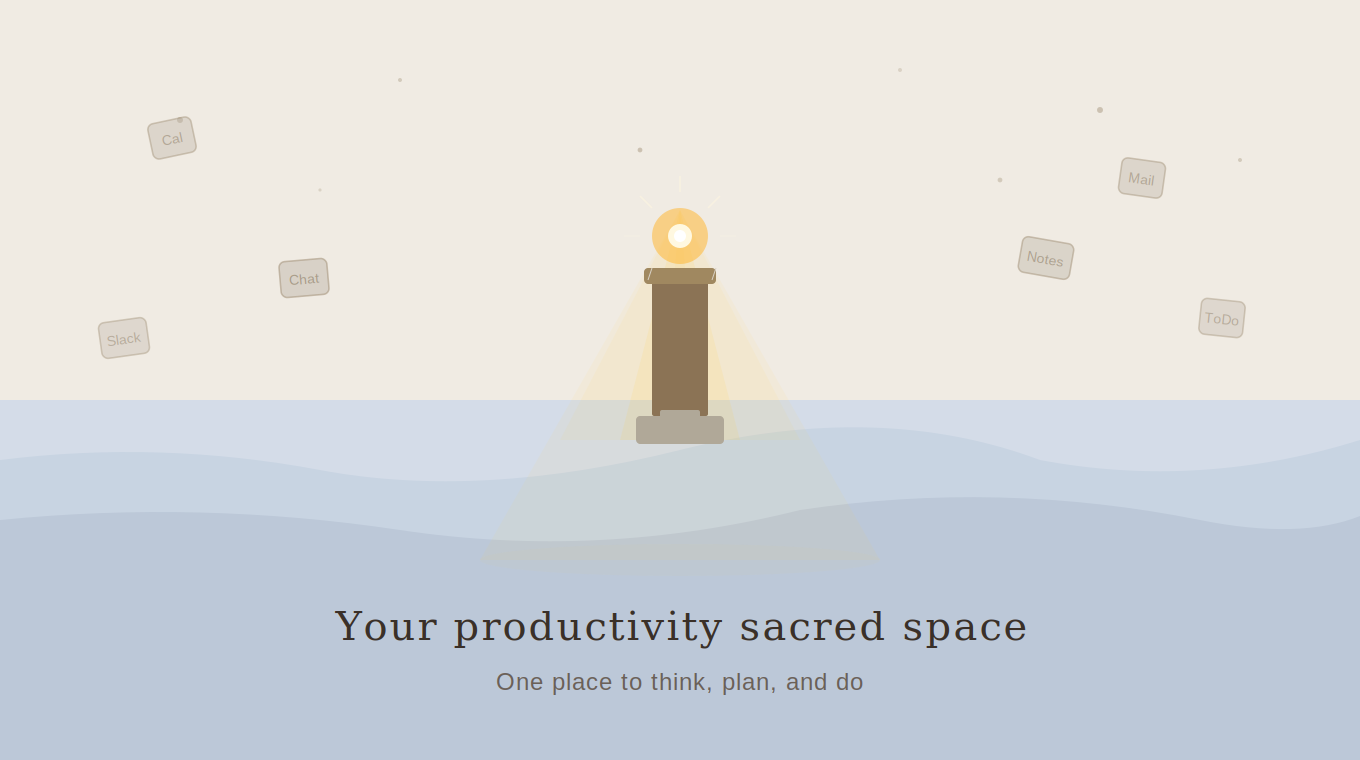
We are not lazy. We are scattered. And the scattering happens because there is no single anchor — no lighthouse that says, “Start here. Everything you need is here.”
A sacred space is that anchor. One place where your focused effort, your top priority, and your quick captures all live together. No app-jumping. No context-switching. Just clarity.
Simple idea. Surprisingly hard to find.
My journey so far
Phase 1: The Calendar
I was a calendar person for a long time. Time-blocking. Color codes. Every hour accounted for. It felt clean and controlled.
Then remote work happened. Home-office days where a “9 AM deep work” block disappears to a real-life interruption. Travel weeks where my calendar looks like modern art across time zones. The structure that helped me started fighting me.
Calendars are brilliant for commitments with others. For personal productivity? Too rigid.
Phase 2: The Task Manager
I moved to Todoist. Writing ideas, meeting plans, daily to-dos — everything went into one app. It worked as a “sacred space” for a while.
But here is what I learned: a task manager is built for doing, not for thinking. There is no room to develop an idea, to reflect, to write something that does not have a checkbox next to it.
I needed a space that could hold action and thought.
Where I am now: two contenders
Superlist — the action space
I recently switched to Superlist as my primary task manager and I wrote about that transition a few weeks ago. What earned it a place in this conversation is not just the speed or the design (though both are excellent). It is how it connects notes to tasks.
A to-do is not just a line item anymore. It carries context. A rough meeting agenda lives inside the task itself. A half-formed blog idea sits in my idea inbox. Superlist lets me capture without breaking flow — and that matters more than most feature comparisons will tell you.
Obsidian — the thinking space
If Superlist is where I act, Obsidian is where I think.
I came to Obsidian wanting one thing: a simple notes app that syncs reliably between my laptop and my Pixel. What I found was a daily practice that might be the best productivity habit I have built.
Every day, one note. Ideas, work pointers, meeting takeaways, random observations — it all goes into today’s daily note. And then I connect it. A client problem links to the project note. A blog idea connects to my writing folder. Nothing is lost. Nothing is forced into a structure before it is ready.
For someone whose work spans technical writing, field engineering, and creative projects, this freedom is not nice-to-have. It is essential.
So which one wins?
Neither. Both. I am still experimenting.
But here is what I have realized: the sacred space is less about the tool and more about the practice. It is the discipline of going to one place, first thing, and trusting it.
My current practice looks like this:
→ 3 tasks for the day (no more) → A daily note for everything that is not a task → A quick morning intention and an evening reflection → One weekly review to connect the dots
Whether this lives in Superlist, Obsidian, or something entirely new — that is the experiment running right now.
A little tease
I have been quietly building something on the side. A simple web app — developed with the help of Claude and Lovable — that tries to bring these ideas into one personal space. Not a product for everyone. Just a tool that works for me.
It is early. It is rough. But it is the most interesting productivity experiment I have been part of.
More on that in a future edition.
Your turn: What is your sacred space? A specific app? A physical notebook? A whiteboard? Or are you still looking? Hit reply — I read every response.
Until next week, Kaushik
Systems & Flow — a weekly letter on tools, systems, and workflows that actually work.
Disclosure: This post contains an affiliate link for Superlist. I use it daily and recommend it because I mean it — the small commission is a bonus, not the reason.