

Hey friends,
I need to tell you something that might surprise you.
After spending years — and I mean *years* — exploring, reviewing, and writing about every note-taking app under the sun, I’ve settled down. Me. The guy who has written about 60+ tools. The one who always had a “but have you tried...” in his back pocket.
I’m using Obsidian. And I’m not looking at anything else.
Let me explain why this feels different.
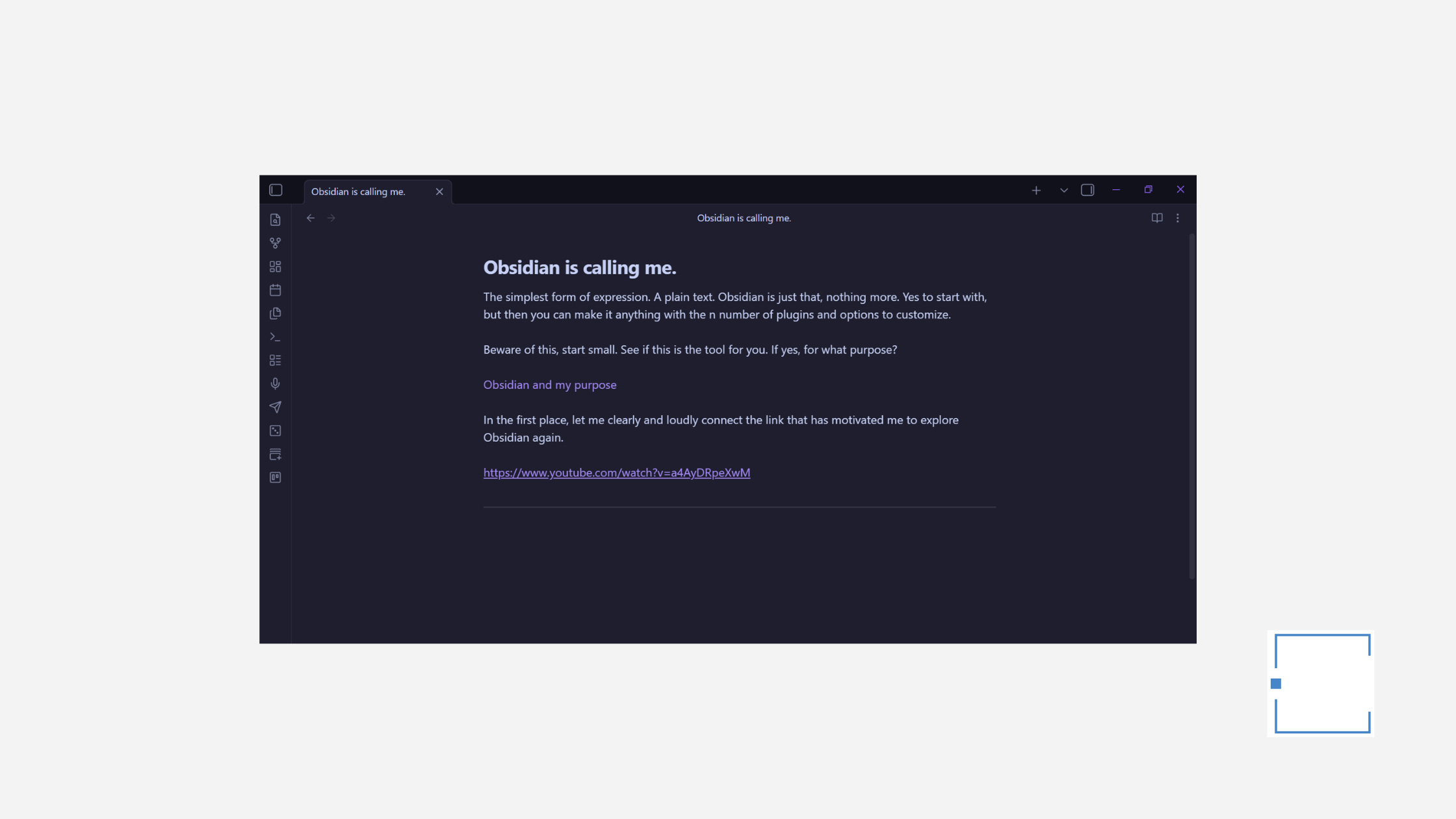
The fear I carried everywhere
Every notes app I’ve ever used came with an invisible weight. A quiet background anxiety that I could never fully shake off:
*What if this app shuts down? What if they change the pricing? What if the sync breaks and I lose six months of writing?*
I carried this fear through Tana, Capacities, Mem, Reflect — through every tool I explored and sometimes fell in love with. Some of these are genuinely brilliant apps. But none of them could answer that one question in a way that fully calmed me down.
Obsidian did. Not with a feature. Not with a promise. But with a fact: your notes are markdown files on your computer. Period.
If Obsidian disappears tomorrow, I open my folder in any text editor and everything is there. Every essay. Every meeting note. Every chapter of *The Departure*.
I cannot overstate how freeing that feels.
I stopped writing for the machine
Here’s something I didn’t expect.
For the past year or so, I had been unconsciously shaping my writing to work with AI. Structuring notes so assistants could parse them. Thinking about prompts while I was supposed to be thinking about ideas. Writing became a performance for an algorithm instead of an act of expression.
Obsidian has no built-in AI. And the moment I opened it, something shifted. I started writing the way I used to write — messy, personal, exploratory. Not optimized for anything. Just... words.
I missed that. I didn’t even know I missed it until I got it back.
The setup that’s actually sticking
You know me — I’ve built systems in Notion that looked like NASA control rooms. I’ve had Tana supertag hierarchies that needed their own documentation. I’ve over-engineered every system I’ve ever touched.
Not this time.
Here’s my entire Obsidian setup:
Two vaults. One for my writing and learning. One for work — projects, meetings, notes from my team. A handful of plugins, nothing fancy. Obsidian Sync to keep things running between my Windows laptop and my Android phone.
That’s it. No 30-plugin stack. No complex templates. No Data view queries pulling data from seventeen folders.
Just notes. Linked when it makes sense. Written when I have something to say.
It’s the most boring system I’ve ever used. And I think that’s exactly why it’s working.
Everything in one place (finally)
For years, my thoughts were scattered across apps like confetti. A draft in Notion. Meeting notes in Capacities. Ideas in Mem. Random thoughts in Apple Notes because I was too lazy to open the “real” app.
Now everything goes into Obsidian. All my words. One place. The question “where did I write that?” has a single answer now, and you have no idea how much mental bandwidth that frees up.
I have 220+ blog posts, an ocean of atomic essays, and three chapters of my first novel sitting in my vaults. All plain text. All mine. All searchable, linkable, and permanent.
What’s coming next
I’m excited about connecting my Obsidian vault — this growing knowledge base of everything I’ve written and learned — with Claude. Not to replace my thinking. To build on top of it. To find patterns across 220 blog posts I’ve forgotten I wrote. To pull threads between ideas that span years.
The writing happens in Obsidian. The thinking-with-AI happens elsewhere. The boundary matters to me now.
A note for fellow app-hoppers
If you’re reading this and you recognize yourself in my story — the constant switching, the hope that the next app will be “the one,” the low-key anxiety about your notes — I’m not going to tell you Obsidian is the answer for everyone. It’s plain text. It requires you to build your own system. It won’t impress you on day one.
But if what you really want is *confidence* — the deep, quiet certainty that your words are safe and yours — then maybe give it an honest two weeks. Start small. Don’t install twenty plugins. Just write.
See what happens.
I’ll be here, writing about the journey as it unfolds.
Talk soon,
Kausik
*P.S. — If you’ve made a similar move recently, reply to this email. I’d genuinely love to hear your story. These conversations are my favourite part of writing here.*