

Hey,
Last week I sat down to set my goals. Same four areas as always — Writing, Finance, Work, Health. I’ve done this enough times to know the shape of it.
Except what came out this time wasn’t goals. It was a list of activities. Habits. A weekly rhythm.
Health: fix sleep, eat clean and fresh, move/exercise 45 minutes, five days a week.
Writing: a daily writing slot, plus a longer session on the weekend.
I looked at that and felt something click. Forget goals. Build the system, and the goals take care of themselves.
Then I read it back properly.
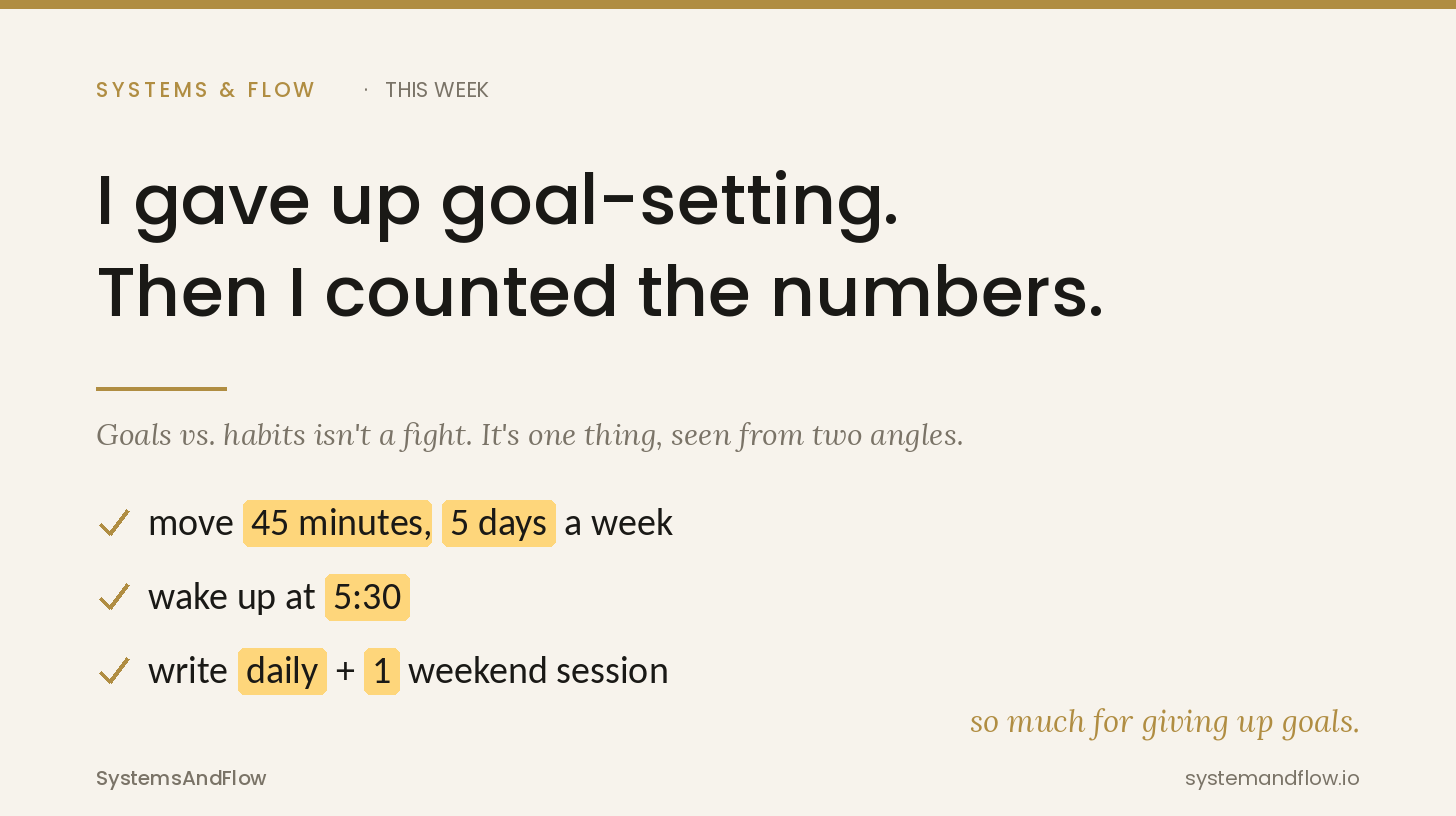
Every single line had a number in it
Forty-five minutes. Five days. Daily. Weekend.
That isn’t a system replacing goals. That’s a goal, broken into pieces small enough to do on a Tuesday. I hadn’t escaped goal-setting. I’d stopped writing the outcome at the top of the page and told myself something profound had happened.
Which is the question I actually want to think through with you this week: are goals and habits two different approaches, or one thing seen from two angles?
I’ve landed on one thing. And the popular version — forget goals, build systems — is true enough to sell and wrong enough to cost you a year.
What the systems argument leaves out
A habit has no opinion about whether it’s working.
That’s the whole problem. You can move for 45 minutes, five days a week, for eight months, and be slower and heavier at the end than you were at the start. The habit won’t tell you. It has no way to know. It was built to be repeated, not to be right.
The outcome is the thing that tells you the system is wrong. Take it away and you’re left with a routine that’s very good at surviving — which is not the same as a routine that’s working. Habits drift toward comfort. Unmeasured, they get easier, and they stay. And that feels like consistency.
I had a live example sitting in my own plan and walked right past it.
My sleep “system” was broken, and I’d have run it for months
Under Health, I had written: to fix my sleep — wake up early.
Read that again. Waking early doesn’t fix sleep. It fixes wake time. Sleep is decided at the other end of the day, when I put the phone down. If I move the alarm and not the bedtime, I’ve built a system that produces less sleep and calls it discipline.
And I’d have run it for months. Ticking the box every morning. Feeling consistent. Getting worse.
The only thing that catches that is an outcome — not “did I wake at 5:30,” but “am I rested.” The habit couldn’t catch it. The habit was the problem.
I already knew this from my day job
Twenty years in sales, and I’ve watched this exact argument play out with a different vocabulary.
Every rep has a number. Every rep also has activity metrics — visits, calls, trials, samples. And there are two ways to run a team badly.
You can manage only the number. Then nothing happens for ten weeks and everyone panics in the last two, discounting whatever will move.
Or you can manage only the activity. Twenty visits a week, every week, beautifully logged. A team that is genuinely busy and closing nothing, because nobody asked whether those were the right twenty.
Nobody who has actually run a team believes you pick one. You need the number to know whether the activity is the right activity, and the activity to have any chance at the number. One system: a direction and an engine.
Personal productivity is the same thing minus the manager. That’s the only real difference — nobody is sitting across from you in January asking why the activity isn’t converting. You have to be that person for yourself. Which is exactly why “just build habits” is such comfortable advice. It removes the one uncomfortable conversation.
So what I’m actually changing
Structurally, not much. The habits stay. They were the good part of last week’s exercise.
What goes back on top of each one is a number and a date to look at it. Not to chase — to check. The question stops being did I keep the habit (I already know I can keep a habit) and becomes did keeping it produce anything.
Review the outcome monthly. Change the habit when the outcome says so. That’s the entire adjustment.
And one more bit of honesty, since I’m here.
Last week I also committed to weekly long-form, a poem, getting back to the novel, an hour of training, fixed sleep, and cleaner eating. All starting the same week.
That’s six installs at once — which is the goal-setting mistake I had just congratulated myself for escaping, wearing better vocabulary. Systems compound because you add them one at a time and they survive a bad week. Six at once is a resolution list in a nicer jacket. The training hour is real; it has months behind it. The writing starts now. The rest are intentions I’ve written down, and I should call them that.
Where I’ve landed
Goals and habits aren’t two philosophies to choose between. The goal is direction. The habit is the engine. Direction with no engine is a wish. An engine with no direction is a very disciplined way of going nowhere.
“Systems over goals” spread so well because it’s a genuinely good correction to the bad version of goal-setting — the January list with no mechanism under it. It was a correction. It got mistaken for a replacement.
Keep the number. Just stop staring at it, and go do the Tuesday version.
How do you handle this one? Do you keep an outcome target, or have you gone fully habit-based?
If you’ve dropped targets entirely and it genuinely worked, hit reply — that’s the version of this I’m least sure about, and I’d rather hear it from someone who’s lived it than argue with it in my head.
Talk soon,
Kaushik - SystemsAndFlow