

You know my history with AI writing tools. I’ve been skeptical — loudly, repeatedly skeptical — about anything that tries to sit between me and the page.
I wrote an entire piece about keeping AI out of my Obsidian vault. I meant it. That boundary still stands.
So I want to be upfront with you: what I’m about to tell you surprised me too.
I’ve been using an AI writing tool daily for the past few weeks. Voluntarily. And I haven’t wanted to stop.
The tool is called Eden. And the reason it works for me is simple — it doesn’t try to write for you.
I have an already active subscription of Eden (earlier Kortex) and this is an attempt to clear my head and start using this new Eden as a content creator.
Let me explain what I mean, because that distinction is everything.
What Most AI Writing Tools Get Wrong
They want to be the writer. They suggest your next sentence, finish your paragraph, turn your rough notes into polished copy. The output is clean. It sounds coherent. It just doesn’t sound like you.
I spent about a year testing this. Drafting with tools that autocompleted everything. Asking models to “sharpen” paragraphs before I’d even finished thinking them through. And at some point, my writing started to feel like meeting minutes from a conversation I wasn’t fully present for.
That’s when I went back to basics. Plain text. A blinking cursor. My own half-formed thoughts.
My voice came back. My thinking came back. And I assumed that was the end of AI in my writing process.
Then I tried Eden, and I had to update that assumption.
What Eden Actually Does
It doesn’t write. It researches, it structures, and it listens — and those three things turn out to be exactly what I needed.
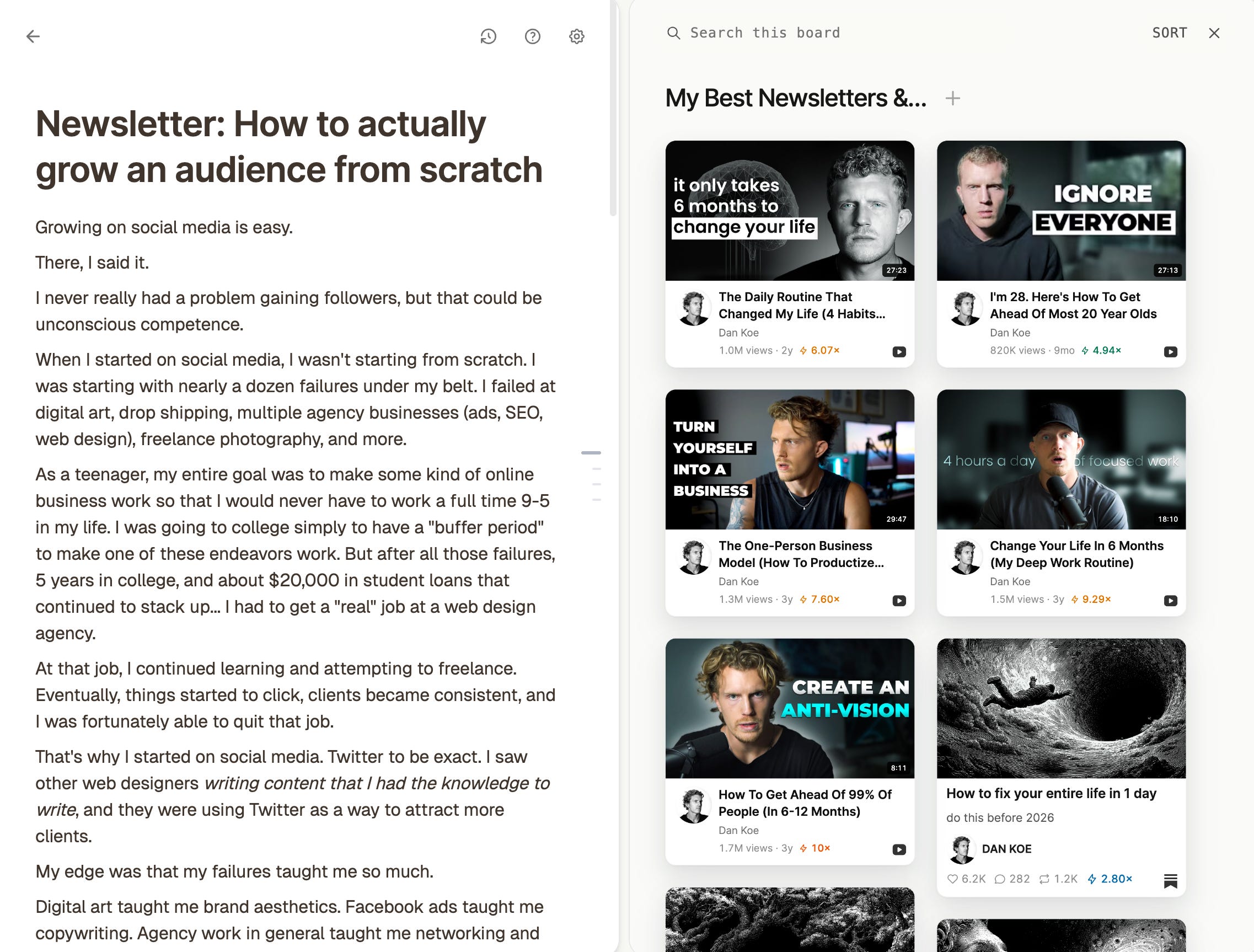
It finds what’s already working. Eden indexes high-performing content across X, YouTube, LinkedIn, Instagram, TikTok, and Substack. You can search by topic or format and see what’s actually resonating — with outlier scores showing how much a piece outperformed the average. You’re not guessing. You’re starting from data.
It breaks down why something worked. Paste in any post or video — yours or someone else’s — and Eden maps the structure: the hook, the beats, the payoff. Then it applies that structure to your idea. You’re not copying anyone. You’re learning the underlying pattern and using it yourself. Over time, you internalize it.
It learns your voice. You feed it links to your own writing — posts, newsletters, threads — and it builds a profile of how you actually write. Your rhythms, your vocabulary, the things you’d never say. When it gives you feedback or brainstorm suggestions, it speaks back in your register. Not LinkedIn-autopilot. You.
What Changed for Me
The parts of writing I used to dread — finding the angle, deciding if an idea is worth the words, staring at a blank page — are no longer the bottleneck.
I still do all the thinking. I still do all the writing. But the research and structure that used to slow me down? Eden handles that. And because it’s not trying to replace my voice, what comes out still feels like mine.
I keep AI out of my private Obsidian vault. That hasn’t changed. But for the work I publish — the essays, the ideas I want you to read — I’ve found a tool that helps me show up more consistently without watering down what I’m putting out.
If any of this resonates, it’s worth a look.
👉 Try Eden free for 7 days — no card required
Affiliate disclosure: I’m part of Eden’s affiliate program. If you sign up through the link above, I may earn a commission — at no cost to you. I’ve been using Eden daily for weeks. I wouldn’t write about it otherwise.
See you next week,
Stay Productive, keep writing.
Kaushik/SystemsAndFlow