

Hey friends,
A short, honest one this week.
If you’ve been reading SystemsAndFlow for any length of time, you know I’ve covered 60+ productivity apps. What I haven’t talked about as openly is how many of them were silently auto-renewing on my card without doing real work for me.
Earlier this year I sat down with my bank statement and counted five productivity subscriptions I hadn’t opened in over a month. The honest reaction wasn’t guilt. It was what is this still doing on my card?
So I cancelled them. Then I waited to see if my output cratered.
It didn’t. It got faster.
This is the short version of what I cut, what I kept, and a few industry signals I noticed afterwards that made me feel less alone in the call.
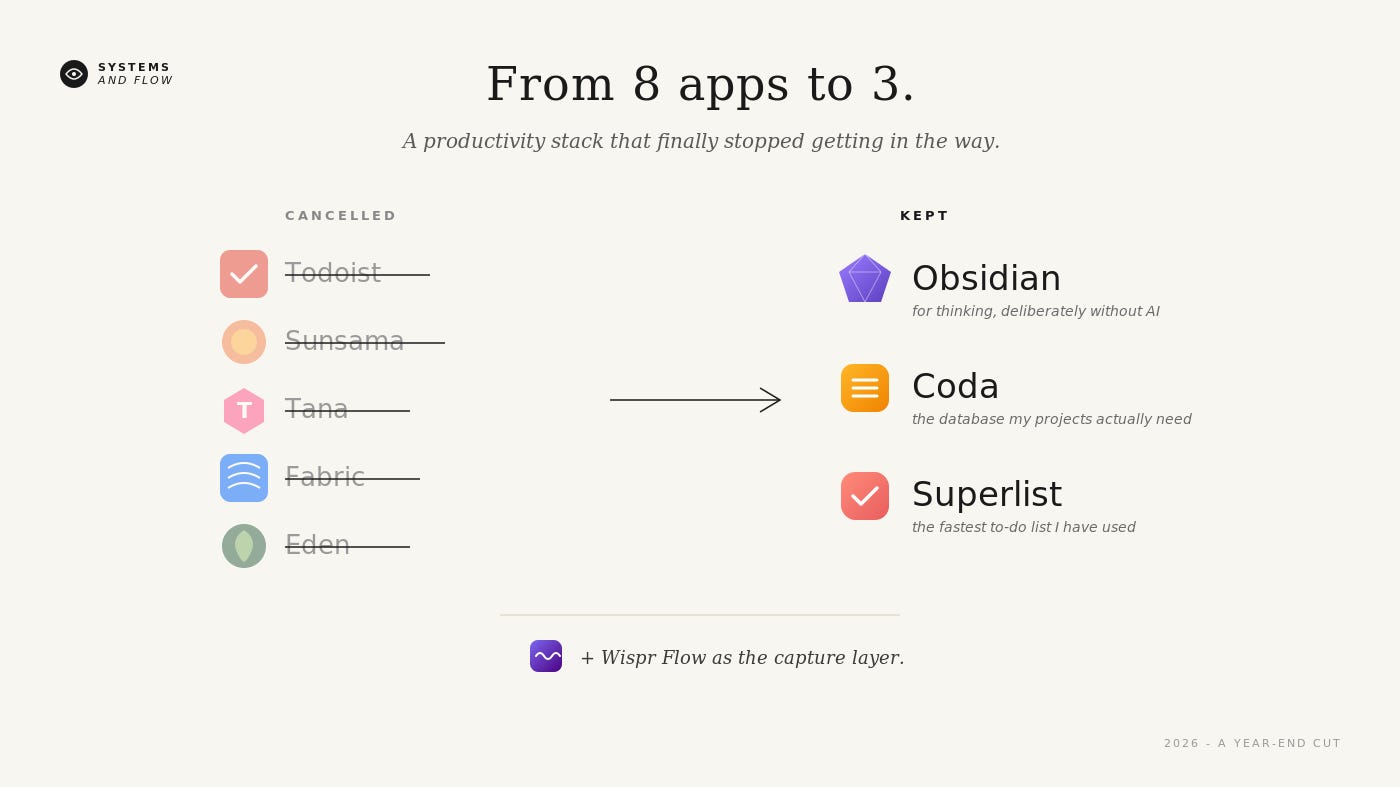
The five I walked away from
Todoist. Years of loyalty. But by mid-2025, the labels and filters had become a system to maintain instead of a system that worked. The tipping point was a Monday morning when I genuinely couldn’t decide what was urgent because everything had three labels. That’s not a tool problem — that’s a tool built for someone who wants to think about tasks, not do them.
Sunsama. This one hurt. The daily ritual is beautiful. But sitting down for a “thoughtful daily plan” only works when your day is plannable. Mine isn’t. Customer escalations and engineer pings tear up my morning by 10:30. The ritual became a form of pretending. When the calendar doesn’t reflect reality, the calendar isn’t the problem.
Tana. The most powerful tool I’ve ever used. Also the one that wanted me to think about how to think every time I opened it. I’d open Tana to capture a meeting note and lose forty minutes redesigning a supertag schema. Cognitive overhead I stopped being able to afford on evenings and weekends.
Fabric.so. Beautiful capture, almost zero retrieval. I was saving into Fabric, never pulling from it. When I needed customer notes I went straight to Obsidian or Coda. A capture tool you don’t withdraw from is just a savings account you never visit.
Eden.so. Smart product. But I already pay for Claude, and Claude does almost everything Eden was offering for me. Two AI layers stacked on top of each other was just overlap with a price tag.
The three that earned their seat
Obsidian is where my thinking lives — and yes, I have deliberately kept AI out of it. Every notes app on the market is racing to bolt AI onto your notes. After reviewing enough of them I’ll say it plainly: when AI starts surfacing and “connecting” your notes for you, you stop thinking through them. The friction of articulating an idea is the whole point of writing it down. AI smooths the friction, which is the same as smoothing the thought. Obsidian gives me the canvas, the local files, the structure. The thinking is mine.
Coda is what most people want Notion to be when they’re managing real work. My territory plans, customer pipelines, quarterly reviews, and editorial calendar all live here. For a B2B operator who tracks structured information that other people consume, nothing comes close right now.
Superlist is the speed layer. Capture-to-organized time is roughly half what it was in Todoist. The mobile app is genuinely fast. The list of features it doesn’t have is itself a feature.
Capture sits on top of all three: Wispr Flow lets me dictate straight into whatever window is open — voice into Obsidian for notes, into Superlist for tasks, into a Coda inbox for thoughts to develop later. Same tool, three destinations, no friction.
The signals that say I made the right call
Two things I noticed after I made the cuts that quietly confirmed them, and that I didn’t see coming:
Eden’s pivot announcement this week. Their team admitted publicly that AI-credit costs broke them and forced a major rebuild — they let go of more than half the team and pivoted to a content-creator-focused outlier discovery tool. That’s a brutally candid public letter and worth reading if you’ve ever wondered how self-funded productivity startups handle the unit economics of AI. (More on this in next week’s post — I’ll be revisiting the new Eden properly, but this time as a writer rather than a B2B operator. I’ve signed up for their affiliate program for that reason.)
Tana’s product split. Tana itself has now split into two: the flagship is moving toward an AI meeting notes app, and the original outliner experience is being preserved as Tana Outliners. Even Tana decided the all-things-to-everyone version was hard to keep as a primary direction. I’ll let you draw your own conclusions, but it lined up uncomfortably well with the reasons I left.
The honest math
Roughly ₹X per month back in my account. The bigger win — 30–45 minutes a day I used to spend on meta-work (grooming labels, redesigning schemas, planning tomorrow’s perfect day) is now spent on actual work or genuinely closing the laptop.
Three tools is enough decision-making. Eight is a soft, constant tax on attention.
The takeaway, if you want one
The best productivity stack isn’t the most powerful one. It’s the one you stop noticing.
Obsidian, Coda, Superlist, with Wispr Flow on top, has disappeared into the background of my work. That’s the highest compliment I can give a tool.
If you’re staring at your own bank statement this week — start cancelling. You’ll be surprised what survives.
Hit reply and tell me what you’ve cancelled this year. I read every email — those notes are usually where my next post starts.
Stay productive,
— Kaushik / SystemsAndFlow
A note on affiliates: I’m an affiliate for Superlist, and Wispr Flow — these has earned the recommendation by surviving the cuts. I’ve also signed up for the new Eden’s affiliate program, even though I cancelled the old Eden in this very post. They’re different products with different audiences, and I’ll only recommend the new one after I’ve actually used it. Full transparency is the only thing keeping this newsletter worth reading.
P.S. Next week: a closer look at the Eden pivot — what it tells you about every other “AI-native productivity” subscription still on your card.