

Hey,
It’s 8 pm. I’m in a hotel lobby between two customer visits.
In the last ten hours: a plant manager asked for a trial report I thought was already sent. One of my engineers needs a price approval before Thursday. A distributor wants a call back. And somewhere in the middle of the second visit, I promised a customer a product data sheet that I have already half-forgotten.
None of this is hard work. The hard part is that it all arrives in 30-second gaps: in a car park, over chai, walking out of a plant. And most productivity systems are built for someone sitting at a desk.
I’m not at a desk most of the week. So I built something for the car park.
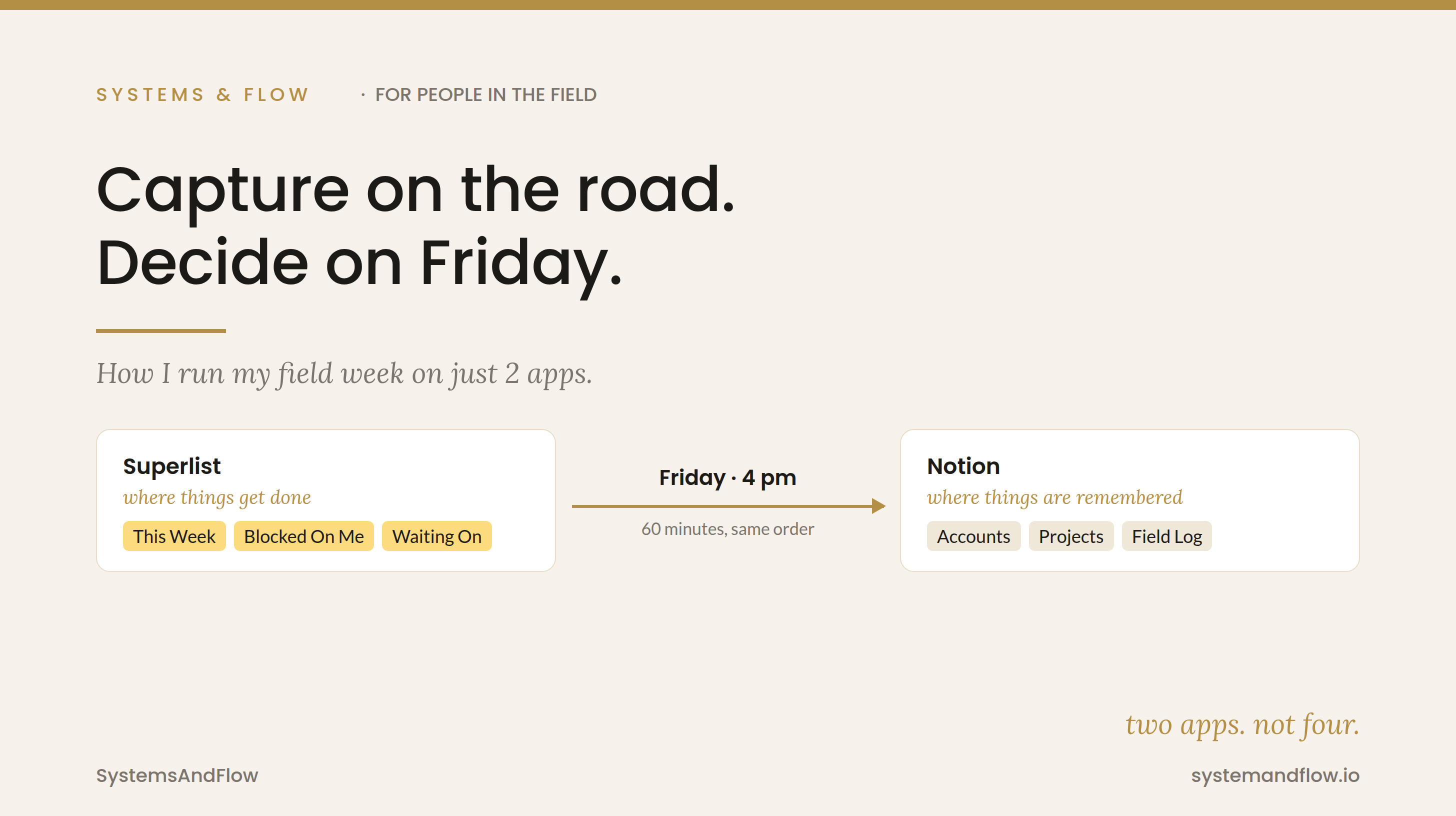
It’s two apps. Not four.
Why field work breaks most systems
If you work in the field (sales, service, application engineering, site work), you already know the problem.
Capture happens everywhere. Review happens nowhere.
You write things down in the moment: in a notes app, on WhatsApp to yourself, in a pocket diary, in your head. Then the week ends, and nothing gets pulled together. By Monday you’re running on memory and whoever shouted loudest.
I’ve tested more than 60 productivity apps over the years. The fix was never a better app. It was giving two apps two jobs that don’t overlap, and one fixed hour every week where they talk to each other.
App 1: Superlist — where things get done
Superlist is my system of action. If something has a next step, it lives here.
I picked it for one reason that matters a lot in the field: a task can hold notes. When I walk out of a customer meeting, the follow-up and what the customer actually said are one thing, not two. In Superlist I capture the task and dump the context under it. Same place, same tap.
My lists are boring on purpose:
This Week — the only list I open in the morning
Blocked On Me — things waiting on me, not on anyone else
Waiting On — things I’ve handed off and need to chase
One list per engineer — what I owe them and what they owe me, ready for our next call
Monthly Priorities — the few things that should shape the month
The one rule on the road: raw is fine. I don’t tag, file, or organise anything in a hotel lobby. I just get it out of my head.
App 2: Notion — where things are remembered
Notion is my system of record. Accounts, projects, distributors, my team, and a field log of visits. (Actually, I designed my system with Coda (Docs by Superhuman but shifted to Notion 6 weeks back)
Here’s the part people get wrong with Notion: I don’t browse it. The databases have a lot of fields, and I almost never look at all of them. If a record matters this week, it shows up in a view. If it doesn’t show up, it doesn’t need me this week.
Monday to Thursday I barely open Notion, except when I’m about to walk into a customer and need to know what happened last time.
The rule that keeps them apart
Superlist answers: what do I do next?
Notion answers: where does this stand?
So when I’m unsure where something goes, I ask one question: does it have a next action?
Yes, it goes to Superlist. If it’s something I’ll need to look up in three months (a trial result, a price discussion, a competitor’s move), it goes to Notion.
That’s it. When two apps can both hold notes, you need a rule like this, or you end up with the same visit written in two places and trusting neither.
The Friday hour: where the system actually works
Everything above is just storage. This hour is the system.
Friday, 4 pm. Sixty minutes. Same order every week.
Empty the Superlist inbox into Notion. Visit notes go to the field log. Project updates go to the project. Anything with a next step stays in Superlist and gets a date.
Blocked On Me. Clear it or hand it off before looking at anything else. The things stuck on me are usually the most expensive ones.
Team roll call. I go through my engineers one by one with four questions: what moved, what’s stuck, do they need me, is a joint visit overdue?
Top projects. I keep a hard cap of fifteen “A” projects, the ones that change the year. If a sixteenth wants in, one has to be demoted or closed first.
Stale. Anything important untouched for 30 days gets a decision, not a re-read: chase, demote, or kill.
What comes out of the hour is a short list of things only I can unblock. That list goes back into Superlist as This Week, and Monday starts already decided.
What breaks it (honestly)
One thing: missing Friday twice in a row.
Miss once and you catch up. Miss twice and the Superlist inbox turns into a swamp, you stop trusting it, and the temptation is to add a third app to “fix” it. The app isn’t the problem. The missing hour is.
Field weeks don’t always end on Friday afternoon. If mine is on the road, the review moves to Sunday evening, and I protect it like a customer meeting.
A quick note, since some of you have followed my setup for a while: Obsidian is still where I think and write. It just doesn’t run my work week, so it’s not in this post.
If you want to try this
You don’t need my exact lists. Start smaller:
Pick one place to capture on the road. Only one.
Pick one place for records you’ll look up later.
Block one hour a week to move things from the first to the second.
Do that for four Fridays before you change anything else.
You don’t need fewer apps. You need each app to have one clear job, and one hour where they meet.
If you work in the field: where does your system break first, capture on the road or the review that never happens? Hit reply. I read every one, usually from a hotel or an airport lobby.
Talk soon,
Astu — Kaushik, SystemsAndFlow
Affiliate disclosure: I may earn a small commission if you sign up. I use it every day either way.
If someone forwarded this to you, welcome. You can subscribe here.
Find me on X · Medium · Buy me a coffee